Vintage
Cartier
From the Santos and Tank to the Cintrée, Crash and Baignoire: the collector’s guide to Cartier’s most important shapes, eras and design signatures.
Cartier approached the wristwatch as architecture. Its finest vintage watches are defined less by technical spectacle than by proportion, line, typography and the disciplined transformation of geometric shapes.


Watchmaking as design culture.
Cartier’s importance rests on a simple but radical idea: a wristwatch could be conceived as a complete design object rather than a mechanism placed inside a conventional round case. From the early Santos to the many branches of the Tank family, the Maison treated the relationship between case, dial, crown and strap as a single composition.
That approach made shape central to Cartier watchmaking. Rectangles, squares, tonneaux, ovals and asymmetrical forms became durable identities, while Roman numerals, chemin-de-fer minute tracks, blued hands and cabochon-set crowns created a recognisable visual language across very different models.
For collectors, vintage Cartier offers unusual breadth. A restrained Tank Louis Cartier, elongated Cintrée, sculptural Baignoire, rare London Crash or early Santos can all belong to the same design tradition while expressing completely different moods.
Cartier’s greatest watches do not merely tell time. They make geometry feel personal.
The quick collector’s view
Most recognisable
The Tank Louis Cartier: the purest expression of Cartier’s rectangular watch language.
Connoisseur choice
The Tank Cintrée, with its elongated curved case and exceptionally refined proportions.
Best entry point
Selected Must de Cartier Tanks and later mechanical or quartz Santos models in honest condition.
From Parisian jeweller to master of watch shapes.
Cartier’s watchmaking history is inseparable from its wider design culture. The Maison brought the eye of a jeweller to objects intended for daily use, making proportion, surface, symbolism and wearability as important as the movement inside.
Rather than refining one successful case for generations, Cartier repeatedly created new shapes. This willingness to treat the watch as architecture produced a catalogue whose strongest models remain instantly identifiable even when their names are removed from the dial.
Louis-François Cartier establishes the Maison
Cartier begins in Paris as a jewellery house. Its command of proportion, precious materials and decorative restraint later becomes fundamental to the character of its watches.
The Santos and the modern wristwatch
Louis Cartier creates a wristwatch for aviator Alberto Santos-Dumont, allowing him to read the time while flying. The square case, softened corners and visible screws establish one of Cartier’s earliest enduring watch designs.
Tonneau, Tortue and early shape-making
Cartier explores non-round cases through the elongated Tonneau and curving Tortue. These watches demonstrate that the Maison’s formal experimentation began well before the Tank.
The Tank becomes a design system
The original Tank appears in 1917, followed by increasingly distinct interpretations. Parallel brancards integrate case and strap, creating a structure that can be stretched, curved, squared or simplified without losing its identity.
Elegance through variation
Tank Cintrée, Chinoise and other shaped watches expand Cartier’s vocabulary. The period establishes many of the references now regarded as the peak of classical Cartier watch design.
London creativity and the Crash
Cartier London develops a more irreverent identity during the cultural energy of the 1960s. The Crash becomes its defining watch: distorted, surreal and immediately recognisable.
Must, Santos, Panthère and wider access
Must de Cartier broadens ownership, while new Santos, Panthère and Pasha models translate historic design codes into modern luxury watches. Quartz becomes part of the Maison’s design-led approach rather than a contradiction of it.
A Cartier timeline.
The major milestones in Cartier watchmaking are best read as a history of forms. Each important launch either introduced a new shape or found a new way to balance geometry, comfort and visual identity on the wrist.
The dates below identify broad historical landmarks. Individual references, production periods, signatures and case details should still be researched separately before any purchase.
The Maison is founded
Louis-François Cartier takes over the workshop of his master in Paris.
Santos-Dumont
Louis Cartier designs a wristwatch for aviator Alberto Santos-Dumont.
Tonneau
An elongated curved case confirms Cartier’s early commitment to shaped watches.
Tortue
The tortoise-inspired case introduces another enduring Cartier silhouette.
Tank
The parallel brancards of the Tank establish Cartier’s most influential watch architecture.
Tank Cintrée
The Tank is stretched and curved to follow the wrist in one of Cartier’s most elegant forms.
Tank Chinoise
Horizontal brancards reinterpret the Tank through architectural references associated with East Asia.
Baignoire develops
Cartier refines the oval watch form that later becomes known as the Baignoire.
Crash
Cartier London creates one of the most radical and collectible shaped watches ever made.
Les Must de Cartier
The Must strategy broadens access to Cartier design and becomes central to the Maison’s late-20th-century revival.
Santos on a bracelet
The Santos is reinterpreted as a modern steel-and-gold luxury sports watch with an integrated bracelet.
Panthère and Pasha
Cartier expands its modern watch identity through fluid bracelet design and a distinctive round sports-luxury form.
The Maison in its own words.
Period advertising shows how Cartier sold proportion, elegance and cultural identity rather than technical specifications alone.

The four vintage eras.
Vintage Cartier is easier to understand when divided by design culture rather than movement technology. The character of the watches changes as the Maison moves from Belle Époque experimentation to interwar classicism, post-war creativity and wider late-century production.
Each era brings different signatures, case constructions, movements and buying risks. Knowing the period helps establish whether a watch’s proportions, dial, hallmarks and overall execution belong together.
The pioneers
Santos, Tonneau and Tortue establish Cartier as an early master of the wristwatch and of forms beyond the conventional round case.
The classical golden age
Tank Louis Cartier, Cintrée, Chinoise, Baignoire and related shapes define the core of vintage Cartier collecting.
Post-war and London creativity
Production is often smaller and more varied, culminating in the extraordinary London designs of the 1960s and early 1970s.
Must and modern icons
Broader production, quartz movements, vermeil cases, bracelet watches and revived historic designs make Cartier more accessible and diverse.
Six important vintage Cartiers.
This is not a complete catalogue. It is a map of the forms that best explain Cartier watchmaking: the disciplined Tank Louis, pioneering Santos, elongated Cintrée, curving Baignoire, sculptural Tortue and radical Crash.
Each family has its own hierarchy of dimensions, signatures, metals and production periods. These six provide strong starting points for deeper research rather than a definitive ranking of every important Cartier watch.
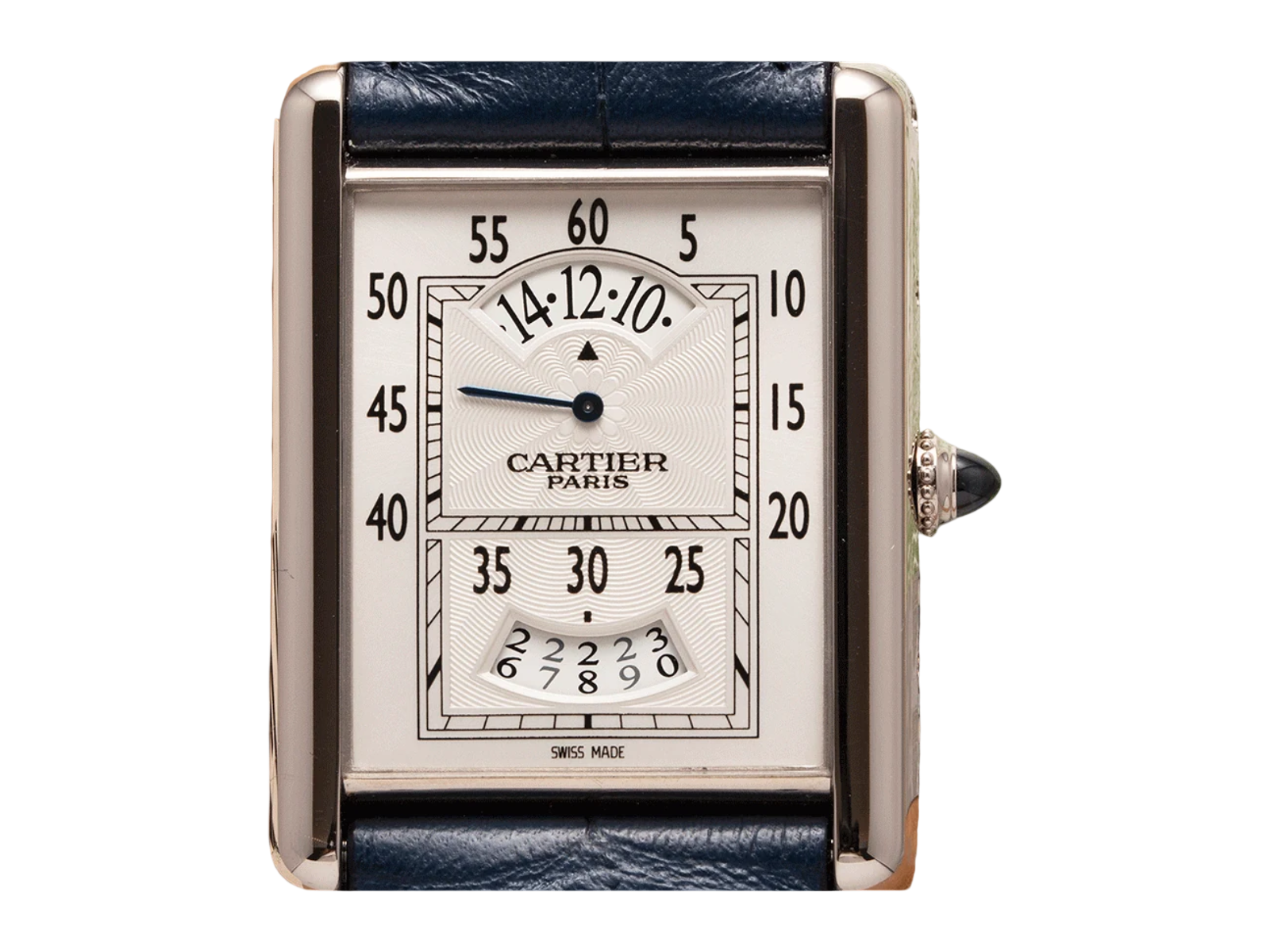 TLC
TLCTank Louis Cartier
The distilled Cartier watch: parallel brancards, Roman numerals, blued hands and proportions that reward restraint.
 S
SEarly Santos
A foundational wristwatch whose square case, curved corners and exposed screws remain central to Cartier’s identity.
 TC
TCTank Cintrée
Elongated, curved and exceptionally elegant, the Cintrée is one of the most admired expressions of the Tank architecture.
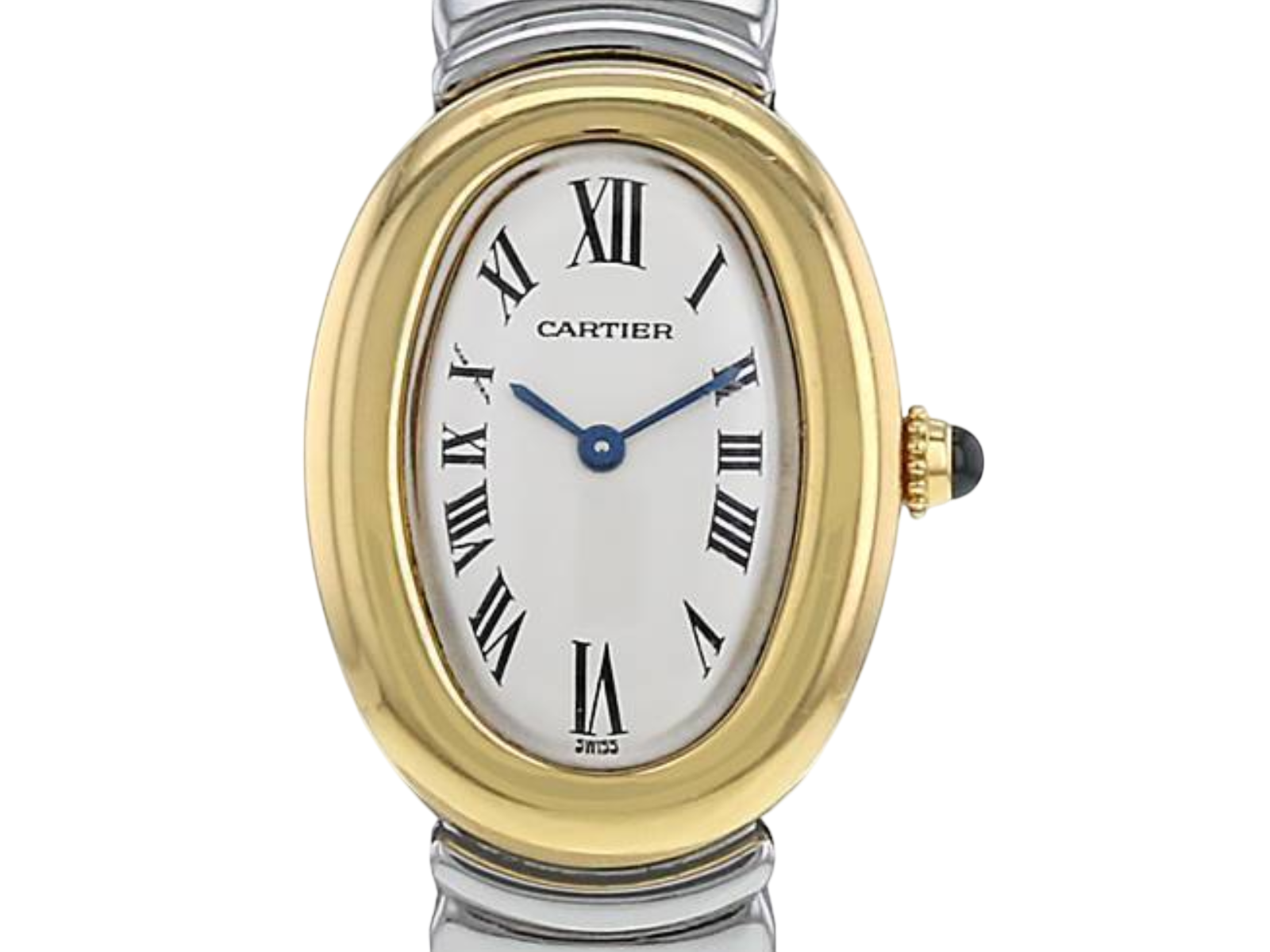 B
BBaignoire
An oval watch whose strength comes from the tension between softness, symmetry and precise case geometry.
 T
TTortue
A curving tonneau-like form that accommodates simple time-only watches as well as some of Cartier’s most important complications.
 C
CCartier Crash
A distorted London design that combines jewellery, surrealism and watchmaking in one of the market’s most collectible forms.
Reading the catalogue.
Old catalogues, advertisements and case drawings help clarify model names, period proportions and the relationship between different branches of the Cartier family.

What makes a vintage Cartier look like a Cartier?
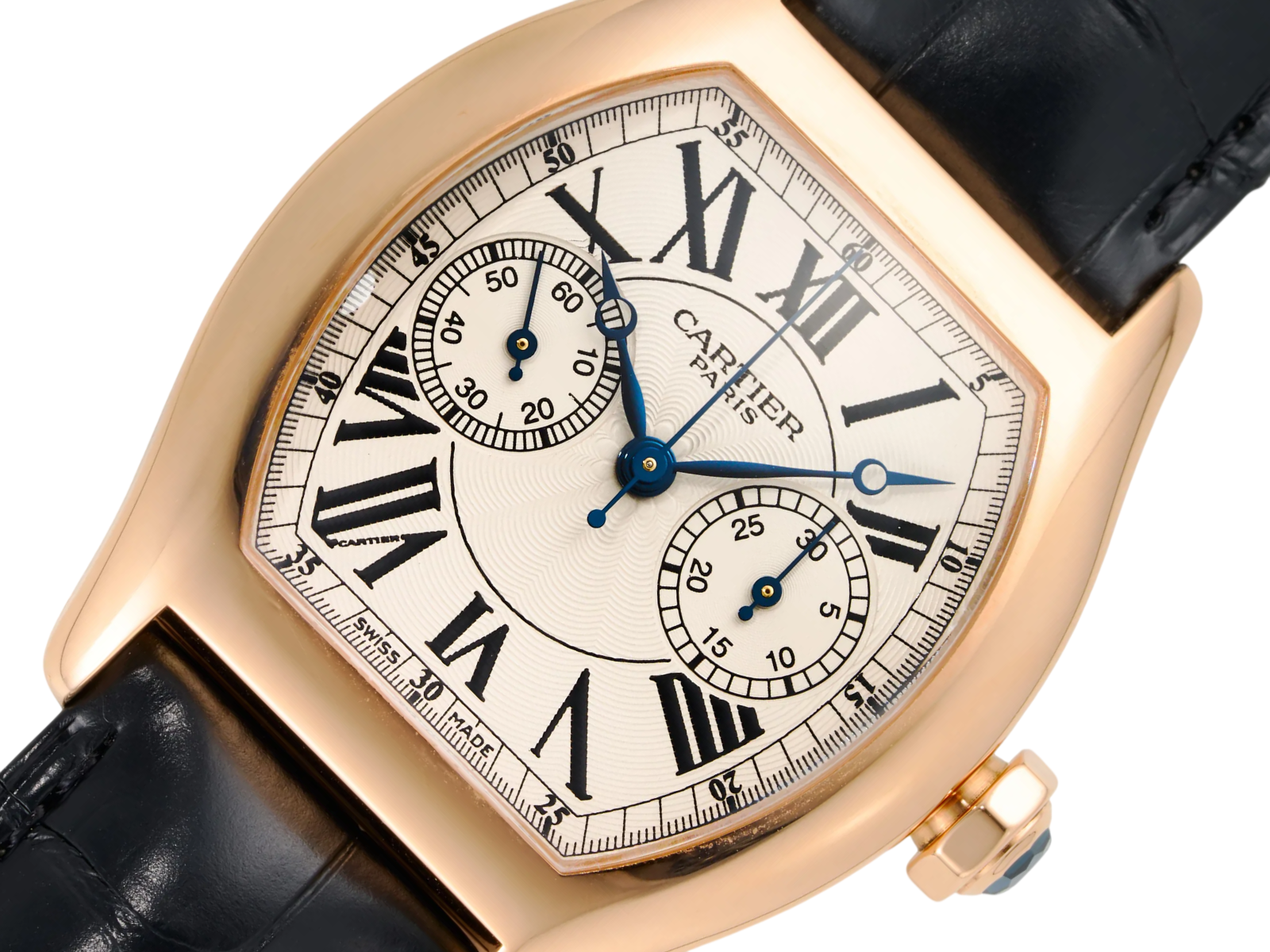
The recurring details are architectural rather than ornamental. Case shape, dial typography, minute-track geometry, hand colour and crown design are coordinated so that even a small watch carries a strong identity.
Learning this vocabulary makes the catalogue easier to navigate and exposes weak restorations. On a convincing Cartier, the case and dial should feel as though they were drawn together.
 T
T
The case is the design.
Cartier’s most important watches begin with shape. The dial, brancards, lugs, crown and strap are organised as one composition rather than separate components.
Roman numerals
Cartier numerals create rhythm around the dial and are often stretched or compressed to suit the case rather than applied as a fixed typeface.
Chemin-de-fer tracks
The railway minute track brings order to the dial and helps establish the relationship between typography and available space.
Blued sword hands
Blue hands provide contrast and a controlled note of colour, particularly against silvered or cream dials.
Cabochon crowns
A sapphire or spinel cabochon turns the crown into a jewellery detail without disrupting the discipline of the case.
Three things collectors learn quickly.
Vintage Cartier rewards sensitivity to proportion. Two watches with the same family name can feel entirely different because of small changes in length, width, curvature or the relationship between dial and case.
Collectors also learn that Cartier originality is complex. Dials were refinished, movements serviced, straps replaced and cases polished; the strongest examples are those whose surviving elements remain coherent and historically plausible.
Dimensions matter enormously.
Cartier watches often wear larger than their measurements suggest. Judge the shape and proportion on the wrist, not diameter alone.
Signatures need context.
Paris, London, New York, Cartier and movement signatures vary by period. No single dial detail should be authenticated in isolation.
Quartz can be legitimate Cartier.
In later vintage pieces, quartz often supports the thinness and convenience central to the design. Mechanical is not automatically superior.
Where the interest sits.
Collector interest is strongest where historic importance, distinctive shape and limited production overlap. That places early Tanks, exceptional Cintrées, London Crashes and rare complicated Tortues at the top of the market.
These ratings are editorial indicators rather than price forecasts. Size, metal, period, dial originality, signature and provenance can transform the desirability of two apparently similar watches.
Very high
Extremely distinctive, scarce and culturally important, with authentication requiring specialist expertise.
Very high
One of Cartier’s purest and most elegant forms, with major differences between periods and executions.
High
The central classical Cartier, valued for proportion, condition and historical coherence.
Very high
Rare shaped complications unite Cartier design with serious traditional watchmaking.
High
Historically foundational and increasingly appreciated, but surviving configurations vary widely.
Medium
An accessible route into vintage Cartier, especially when the dial and vermeil case remain attractive.
Modern Cartier alternatives.
For buyers drawn to Cartier’s historic design language but unwilling to accept the uncertainty and maintenance demands of a vintage watch, the modern catalogue preserves many of the Maison’s strongest forms.
These models offer clearer provenance, stronger water resistance and easier servicing while retaining the proportions, typography and case architecture that made Cartier important.

Cartier Tank
The most direct route into Cartier’s rectangular design language, available in multiple sizes, metals and movements.

Santos-Dumont
A slim, architectural modern expression of the pioneering 1904 wristwatch.

Santos de Cartier
The historic square form translated into a versatile modern bracelet watch.
The Cartier archive is a study in shape.
The Tank may be the natural entry point, but the richest collection moves across Santos, Tortue, Cintrée, Baignoire, Crash and the many unusual forms through which Cartier repeatedly reinvented the wristwatch.